



Share this post
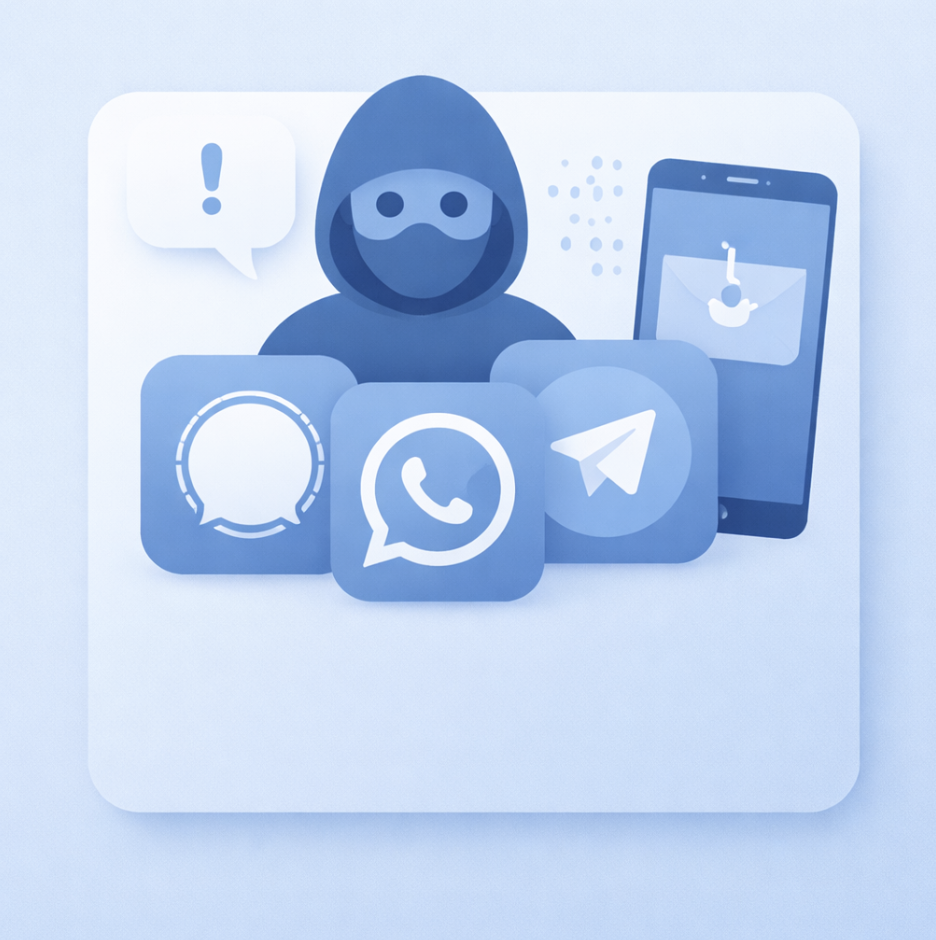
Messaging apps were designed for speed, convenience, and privacy. Platforms like Signal, Telegram and WhatsApp offer end-to-end encryption, instant delivery, and a sense of personal connection that email rarely achieves. Unfortunately, these same qualities have made messengers one of the most effective channels for phishing, social engineering, and spyware delivery. Between January 2024 and November 2025, CISA documented a 347% increase in messenger-based social engineering incidents affecting critical infrastructure sectors, proving that encryption protects data in transit, but cannot defend against manipulated users or compromised devices.
Messages arriving through chat apps feel personal and informal. Users are far more likely to engage with an unexpected message in a messenger than with a suspicious email. This reduced skepticism makes it easier for attackers to initiate conversations, send malicious links, or manipulate victims into taking quick actions.
The effectiveness of messenger-based phishing is amplified by large-scale data leaks and enumeration flaws. For example, WhatsApp user data, such as active phone numbers, names, profile photos, and status text, has been exposed at a massive scale. This information allows attackers to craft highly personalized messages that feel credible from the first contact, rather than generic or random.
Modern messaging apps include features designed for convenience - linked devices, QR-code logins, cloud backups, and cross-platform syncing. We see reports that attackers have repeatedly abused these features to silently attach unauthorized devices to victim accounts or redirect users to phishing pages that closely imitate legitimate setup screens. In these cases, encryption remains intact, but it no longer matters. The attacker simply reads the messages from their own linked device.
Another growing tactic involves distributing fake versions of popular apps. These apps look legitimate but include spyware capable of harvesting messages, contacts, microphone audio, and other sensitive data. Telegram channels have become a particularly effective distribution method, blending legitimate content with malicious impersonations.
CISA warns that attackers increasingly combine social engineering with commercial spyware and remote-access tools. A single deceptive message can escalate into account takeover or installation of spyware. In several recent campaigns, disclosed vulnerabilities WhatsApp in iOS devices were exploited in zero-click attacks, where victims did not need to open a link or interact with a message at all. While these operations often target high-value individuals, the techniques eventually spread into broader criminal use.
This style of attack is not new. It is one of the oldest scam models, constantly reshaped to fit the victim. For some, it appears as a professional opportunity. For others, it could be a reasonable price offer. What has changed is realism. With AI-generated images, voice cloning, deepfakes, and access to leaked personal data, scammers can now create identities that appear more convincing than ever.
Documented victims most often belong to high-value groups, including government and military officials, journalists, executives in critical sectors, and members of civil society organizations. These individuals rely on encrypted messaging platforms as a quick and less formal alternative to email, moving sensitive discussions into messengers by default.
As strong encryption becomes common, attackers no longer try to break it. Instead, state-aligned groups focus on easier paths tricking users, exploiting device weaknesses, and using leaked personal data to gain access without touching the encryption itself.
One important truth: secure messaging does not guarantee secure communication. Encryption protects messages in transit, but it cannot defend against compromised devices, leaked personal data, or manipulated users. Messaging platforms have become an ideal delivery channel for phishing and spyware precisely because people trust them. When combined with massive data leaks, AI-driven impersonation, and sophisticated social engineering, that trust becomes a liability.
As attackers continue to exploit the gap between convenience and security, effective defense depends not only on technology, but also on behavior and knowledge. Skepticism toward unexpected messages, caution with links and apps. For this reason, we now conduct phishing simulations directly inside messaging platforms, recognizing that messengers have become a primary attack surface rather than a secondary one.